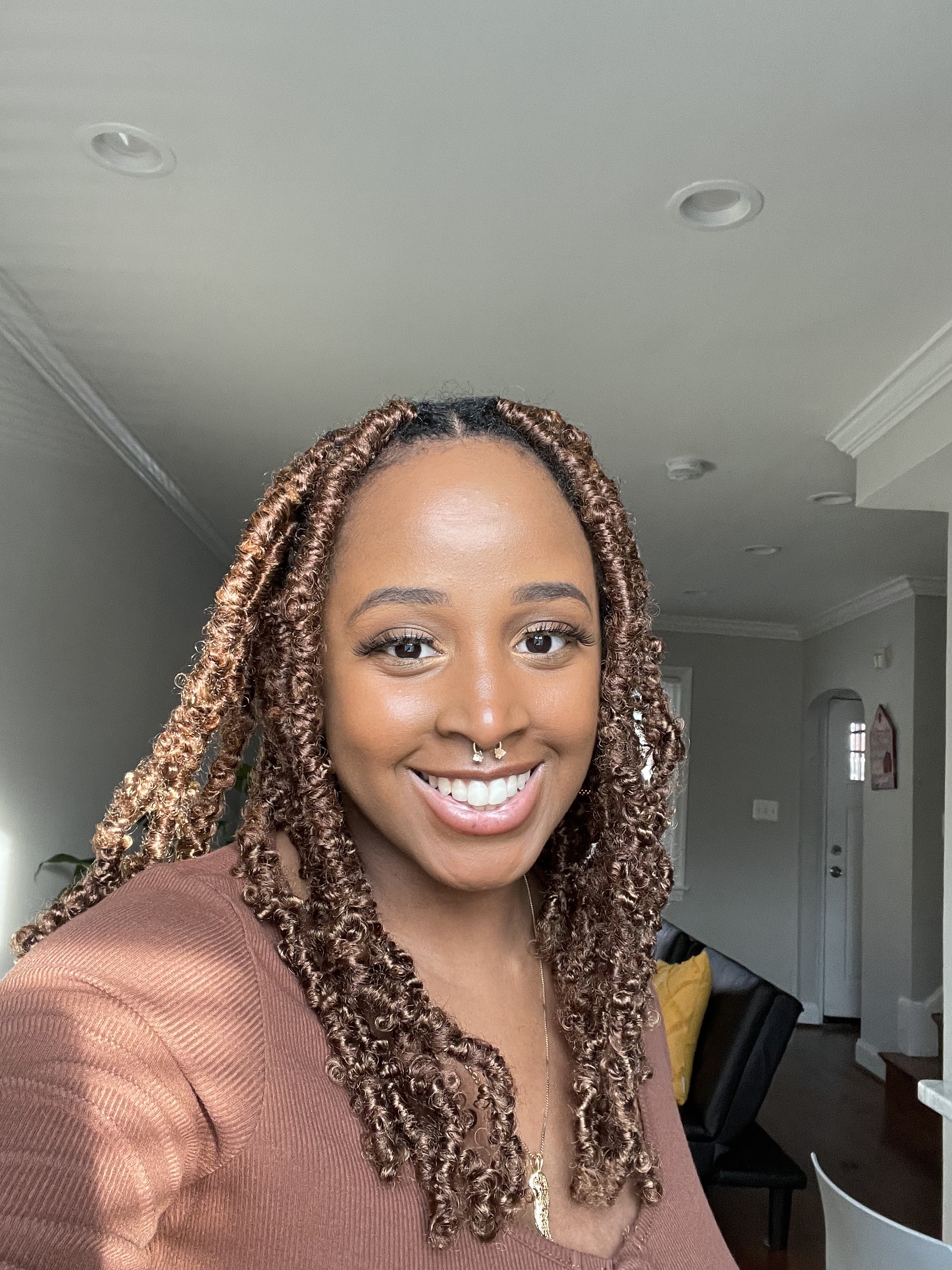
 Ajhani Carroll is ERASE Racism’s Education Program Associate, where she serves as the day-to-day lead in managing the Education Equity Initiative, including ERASE Racism’s Student Task Force and Long Island Leaders of Tomorrow Conferences. She brings experience managing educational programs in the United States and abroad, involving both youth and college students – in such varied settings as on campus, in the community, and in incarceration facilities. She has supported civic-engagement and advocacy initiatives addressing systemic inequities for both the American Civil Liberties Union and Common Cause. Her experience also includes research-supported training, service learning and volunteer services, and event coordination.
Ajhani joined ERASE Racism in early 2026 after teaching English for two years in Spain, where she developed and led lessons for middle school students, adapted instruction for diverse learning levels, and supported classroom engagement. She previously worked for Common Cause in Maryland, where she recruited and trained 50+ HBCU student volunteers, led focus groups to increase civic engagement among youth of color, researched language access barriers, and contributed to outreach strategies informing policy changes.
Ajhani is a summa cum laude graduate of Howard University. While in college, she was an Advocacy & Reform intern with the American Civil Liberties Union, supporting 30+ families affected by police brutality and systemic inequities, and Programming Chair for the Petey Greene Program, which supports the academic and career goals of incarcerated and formerly incarcerated people through high-quality tutoring and other educational programs. There she tutored justice-involved students, providing academic and social-emotional support in a correctional setting, coordinated educational sessions, managed event logistics, and strengthened the volunteer community.
She explains how her commitment to education equity evolved: “Some of my earliest experiences with structural racism came from attending a low-income public school in Long Island. As the granddaughter of immigrants, I was raised to see education as a pathway to opportunity, yet my school often lacked the resources to fully support students who needed it most. I remember visiting nearby schools for athletic and academic events and being struck by how different our environments were. Schools only minutes away had newer facilities, more counselors, broader course offerings, and stronger college advising. Meanwhile, many students at my school struggled to access basic academic support. Although teachers and staff worked hard, limited funding meant resources were scarce and often reserved for a small group of students. I was fortunate to benefit from some of those opportunities, but I could not ignore how many of my peers were left behind.”